As someone who studied biology and biochemistry, I should perhaps have published this Map as one of my first. But maybe I like to keep good things for later.
Heavenly Bodies
The human body is incredibly complex. I studied biology exactly for this reason – the body never ceases to amaze. You can zoom into a cell and discover a giant city. The depths of our biology seem almost endless, and Nature invents the most amazing tricks. One of my favourite facts: our eyes are interacting with quantum particles – photons. Your big lumpy body actually touches the incredibly small every time you have your eyes open. Another amazing fact is the organisation of your body. We are made up of tens of trillions of individual units, cells, all working together. However, for this Map, I will not dive too much into specifics. I want to map the human body as a whole.
Assumptions and Resolutions
First, Crystal Vision asks us to choose a resolution and context for the Map. I wish to examine the general layout of our human body. Interestingly, because of evolution, this means we are also mapping the bodies of many other vertebrate animals as we share many things in that layout.
We would guess that human bodies layouts are not very universal; we would expect great fuzziness and complexity. But no. This map is one of the cleanest ones I made, and I am quite content with its overall configuration. Just keep reading – our biology is super elegant. You need to know a little bit of biology here, but I will do my best to keep this thought accessible to anyone.
Genes
During my studies, some 10 years ago, when we discussed the body plan layout, I was struck. This might have been the first moment I was certain there was much more Order than Chaos in nature. The Map is one of my first and the one that ultimately prompted the entire Codex – long before the Solar System and music. Nature has a very clean Map of the body laid out in the HOX genes.
Let’s slow down and explain what genes are first. Imagine your DNA as a huge library, and genes as its books. Each book holds the recipe for one molecule your body can make. Here is the first miracle: almost every cell in your body carries the complete library. A skin cell and a brain cell own exactly the same books. What makes them different is which books they open. So a gene is not just a message, it is also a switch: open or closed, on or off. When you dive headfirst into genetics, you will quickly realise Nature is not especially tidy: there are genetic webs, clusters, families, doubles, feedback loops... There is not one single “eye-colour” switch. Instead eye colour is determined by a whole group of genes, and to make it more complex, those genes also regulate other things than eye colour. It is mind boggling how complex genetics can get (and then we didn’t even look at epigenetics and mRNA modification...)
HOX Genes
But out of all genes, the HOX genes are extraordinarily ordered. They are almost simple. Almost. But let’s stay focused on the overall architecture, because that is what these HOX genes determine. If you imagine a little budding embryo in a mommy’s belly, which is just a clump of cells in the beginning, it has one major question to answer: “which way do I grow?” Now imagine that inside that little clump of cells, a line forms, running from head to tail (from mouth to rectum, if you like). And along this line, the HOX genes will determine what grows where. They are incredibly sequential.
HOX genes do not build anything themselves. They are not recipes for an arm or a lung. They are addresses. A HOX gene tells a cell where it lives along the line: “you are neck”, “you are chest”, “you are lower back”. The cell then knows which books to open that suit its neighbourhood.
And now the part that made me fall in love. The HOX genes sit on your DNA in the same order as the body parts they label. Read a HOX cluster from one end to the other, and you walk down the body from head to tail. On top of that, they switch on in that same order in time: the head-end genes first, the tail-end genes last, like a row of lights flicking on one by one down a long corridor. Order in the DNA, order in space, order in time. Biologists have a dry word for this – collinearity – but I call it one of the most beautiful facts in nature.
One more rule makes the whole system work: where several HOX genes are active in the same spot, the later one in the row usually gets the final say. The newest address wins. Keep that in mind; it will matter once we reach the end of the line.
And the system is ancient. Fruit flies have HOX genes too, lined up in the same order. Switch one of them on in the wrong place, and a fly can grow a pair of legs on its head, right where its antennae should be. Flies, fish, mice and humans all build their bodies with versions of the same address system. We are, quite literally, variations on one very old theme.
Scientists recognise 13 different HOX gene groups (humans carry 39 HOX genes in total, spread over four clusters on four different chromosomes). The first groups act more at the beginning of the head-to-tail line, whereas the last groups act mostly at the end of the line. It is a really neat sequence.
I shall not dive much deeper into the evolutionary development of these genes, although it is super interesting. The general idea is that these groups kind of got copy-pasted (duplication events) – early in vertebrate history, the entire cluster was even copied twice, which is why we carry four sets – and then grew to become unique switches over time. During that history, we even lost some of those switches again. As you can imagine, Nature is messy here too, so we will not make it too complex.
A Line With Beginning and End
Back to that head-to-tail line. It is important to note that we use that line as a metaphor; the mouth and the rectum do not even exist at this stage. But the idea of a line with a sequential pattern should have made an analytical Timeseer go “Ping! This is a highly mappable structure!” And it is indeed.
First there is a problem we need to solve. Scientists make 13 groups of HOX genes. That does not fit our Base-12 Crystal Vision system... But then, scientists sort these genes into groups based on their DNA sequence and their position in the cluster. We map Elemental patterns – based on similar functions, but we are more free to rearrange the mappings. So, without further ado, let’s map!
E1: HOX-free region
We start immediately with a paradox. At the beginning of the line, there is a region where the HOX genes are not in control of anything. The face and the brain are mostly determined by other genes. We will not discuss those genes here. But there is something incredibly interesting: this HOX-free region, contains another full E1-E12 Map. I will not discuss the brain map here – got to stay focused on the whole body.
Mapping:
But the beginning of the line, the brain and the face, map perfectly to the E1 as the ‘pure beginning’. This region is the centre, containing its own full Universe, and from which the entire whole of the body sprouts. Also interesting, when considering E1’s role as the feature defining identity, is that we often watch the head of others first when we identify them. Our head is most defining of our sense of identity.
E2: HOX1, Skull and Body Foundation
The first group of HOX genes, inconveniently called HOX1, maps to E2. This group of genes acts as the fundamental connector of E1 and the rest of the body. HOX1 plays a crucial role in the growth of the brainstem and the basis of the skull, the foundation of facial nerves, the development of head arteries, the construction of the walls and channels of the ears, the coordination of basic eye movements, the setting of the breathing rhythm, and the building of part of the heart’s outflow, where the big arteries leave the heart.
Mapping:
This HOX group maps almost too cleanly to E2. We have got the Stone as the foundation of the skull, the support that will allow all the further Elementals to thrive on. This group builds the bones at the base and back of the skull, where the head meets the neck, the first walls and structures of the lower skull, and provides the basis for our breathing and blood circulation – two fundamental systems of our biology.
To truly make the mapping precise, it is crucial to distinguish between HOX-1’s function as laying a foundation, and the other HOX groups’ functions as ‘filling’ that foundation with more advanced organs and systems.
E3: HOX2, Signal Receiving Surface
Moving to the HOX2 genes, we suddenly get another type of construction. In its own territory (the second of the embryo’s gill-like arches), this group holds back bone and cartilage growth. So where HOX1 is building bone, HOX2 says “stop”. This is why this HOX group is mostly responsible for constructing small, light, and mobile pieces of anatomy.
HOX2 also plays a crucial role in determining the identity and localisation of different structures in the skull base. A great example is the ear. HOX1 builds the foundation, but HOX2 builds the outer ear: the actual surface that catches sound and guides it inside. Something similar happens in the face: the muscles of facial expression grow out of HOX2 territory, and HOX1 and HOX2 together shape the nerve that moves them. This is why HOX2 is the one that will allow you to have complex and flexible facial expressions.
Mapping:
This one again maps cleanly to E3. It is almost too good to be true that the Elemental of fun actually is the one that puts the smile on your face. But it is true – at least in this map :) Furthermore, the idea of small moving pieces, and the surface that receives signals is a crystal clear match to E3’s role as the primary perceptive Elemental. Eye-1 literally builds the brainstem relay stations that receive touch from your face and sound from your ears. This is really the first opening to perceptual information from outside the brain.
E4: HOX3, Gatekeeper of State Changes
The HOX3 genes control the throat, and they are the first to build whole organs of their own outside of the brain. The first HOX3 organ, the thymus, is a gland that is located in the upper chest. It plays a crucial role in childhood in establishing our immune system by the production of T cell – tiny cells that help attack “other” bodies such as bacteria, viral cells, and parasites. Under the influence of sex hormones, it starts shrinking after puberty.
The other organ under the control of HOX3 is the thyroid gland located in your throat. This gland mainly regulates our metabolic rate and protein synthesis. HOX3 also builds its four tiny neighbours, the parathyroid glands, which are the master regulators of calcium in our blood. The metabolic rate is the fundamental cycle that sets the basic pattern of our bodies inside time. It influences hunger, tissue growth, tiredness, sleep, thinking, and sex drive. It famously produces hormones, molecular messages affecting the entire body, so this is the first organ acting outside of itself (along with the thymus).
Aside from the thymus and the thyroid, HOX3 also builds the great arteries of the neck and a tiny blood sensor sitting on them: the carotid body. These cells constantly monitor the oxygen in your blood and adjust your breathing and heartbeat. Furthermore, HOX3 helps in wound repair.
Mapping:
Again, the mapping to E4 is clean. E4 is concerned with synchronisation. It is the first Elemental that is more concerned with the Other than with the Self Division. E4 is the first Strange Elemental that touches upon the concept of Life itself – mixing the inner world with the outer world (see Thought Consciousness Universal and I Hold the Strangest of Hearts). This section is where we jump from self-centred architecture to systemic regulation. The role in the childhood development (yes, another match) of immunity is also interesting for the same reason. Our immune system is also about touching others and learning to recognise them – even if in this case the others are bacteria.
The metabolic rate is fundamental to our biology as temporal beings with drives, and this matches with E4’s temporal aspect. Instead of being a static machine, we suddenly have a body making us feel hungry, sleepy, and horny. This pushes us to *do* stuff. It literally sets us in motion – we’re touching basic emotions.
The calcium regulation is the cherry on top considering we mapped the elemental calcium to E4 in the periodic table Map. We have cross-map correspondence.
E5: HOX4 and HOX5, Branching Flames
Here we need to fuse two groups scientists normally keep apart: HOX4 and HOX5. However, they do work in the same body region: the lower neck, the upper chest and the shoulders. Also, they divide their work so closely that it makes more sense to read them as one team.
And what a team they are. First, HOX4 has a talent for blood: give blood stem cells an extra dose of HOXB4, and they multiply dramatically. Then, as a team with HOX5, it helps decide where your arms will sprout. The earlier HOX groups built a head and a neck. Now, you suddenly can start reaching.
At the same time, these genes grow the lungs. HOX5 is crucial for shaping the airways, with HOX4 assisting. The lungs start as a single tube that splits, again and again, into a tree with hundreds of millions of tiny air sacs at its tips. HOX5 also keeps the lung tissue elastic throughout life. And right next to that, HOX5 extends the spark of HOX4, by building the nerve cells that drive your diaphragm. Without HOX5 in those cells, the nerves still reach the diaphragm, but they fail to branch out over the muscle, and breathing fails. Every breath you take is fired by HOX5 neurons.
And then there is literal heat production regulated by HOX5. Not all fat is the same: white fat stores energy, while brown fat burns it to produce heat. HOXA5 helps lay out the brown fat around the shoulders and upper back. Yeah... HOX5 almost literally makes fire in the body...
Mapping:
E5 is the Fire Elemental, and maps cleanly to this pair of HOX4 and HOX5. HOX4 is more spark that lights, while HOX5 keeps the cauldron hot. It burns through breathing, it burns fat and it allows the body to build its first real force through arm placement. This region clearly is the first motor, the engine room of the upper chest.
E6: HOX6 and HOX7, Terminal Maturation
Next we fuse two other groups of HOX genes in this Map: HOX6, HOX7. It is so interesting to note that HOX6, HOX7 and HOX8 come from one evolutionary family block. Remember our Asteroid Belt divisions in the Solar System Map? Again, we find that, in the middle, the boundaries between different Elementals are less clear. I fused HOX6 and HOX7 together because they both appear in the chest, but more importantly, HOX7 is the quietest group of all. If we delete both HOX7 genes in mice, their skeletons develop remarkably well – some mild deformities in the top of the ribcage aside. We might also have fused HOX7 with HOX8, and it would not have changed much.
HOX6 is the main group in this mapping. These genes mark one of the clearest borders in the skeleton: the end of the neck and the start of the ribcage. Both in long-necked geese and mice-necked mice, the HOX6 border falls exactly where the ribs begin. HOX6 also helps wire the arms. So, HOX4 and HOX5 helped the placement, but HOX6 gives us the nerve cells to finely control those flappy limbs properly. This is another clear example of how the HOX genes work as a team to create one greater structure.
HOX6 is also the group that is important for the development of a pancreas organ. The pancreas contains small islands of cells that produce insulin and other hormones. When you remove all three HOX6 genes, the precursor cells of these islands still appear – but they fail to mature into working, hormone-producing cells. HOX6 works from the tissue around these islands like a mentor giving an apprentice instructions to reach its professional form.
Finally, one HOX6 gene, HOXB6, keeps the production of red blood cells in check: mice without it make extra early red blood cell precursors. A little “stop, we’ve got enough of what you’re making.”
Mapping:
E6 is Earth, the Terminal Elemental: the one that finishes and refines the Dense Elemental. The main pattern here is maturation. HOX6 takes a precursor cell, a nerve, a blood lineage, and makes them precise, specialised and finished. It also lays down one of the body’s strongest anchor points: the first rib, the beginning of the ribcage that shields the heart and lungs. That structure is so E6: we have got the solidity of Dense, in the Terminal shape of a weird cage that allows flexibility. Earth is where solid stretches to its most flexible form. Notice that E2 • Stone (the skull base) and E6 • Earth (the first rib) are both anchor points of the skeleton.
E7: HOX8, The Balance System
HOX8 sits in the middle of the line and gets E7. In the spinal cord, HOXB8 helps build the upper layers that receive skin sensations, such as touch, itch, pain and temperature. And then something a little bit wilder: HOX8 is also active in a group of immune cells in the brain, the microglia. Mice lacking HOXB8 will groom themselves compulsively. They will groom until they pull out their own fur and wound their skin. They get obsessively neurotic. So here we see a major architectural gene group directly regulating a complex behaviour. It directly links to the balance between enough and too much.
Another HOX8 gene does similar balancing jobs in the body. In the arm, it helps wire the nerves of the hand. Mice without it struggle to open their paws and hold them in a kind of clenched fist. In fat, this gene acts as a modulator. It keeps white fat white, holding back the switch to the energy-burning brown fat we saw earlier in E5. And in the skeleton, it helps define the ribs of the centre of the chest.
Mapping:
E7 is Eye-2, the second perceptive Elemental, Loose and Prime. It is also the midpoint of the circle, and here we are at the midpoint of the line. HOX8 doesn’t build fancy organs. Instead, it seems to keep many different systems in balance. And note that another Eye once again holds an important sensory job: HOX2 (Eye-1) received touch and sound in the face, HOX8 (Eye-2) receives touch and itch along the body. This is again a very clean match with the ‘blank space’ nature of E7.
E8: HOX9, The Threshold
With HOX9 we start crossing down from the chest into the lower body, but we have not reached the end yet. First, HOX9 gives us another stop sign: “stop making real ribs, guys!” Here we get those weird pointy ribs that do not connect to the sternum anymore. Doctors call these our ‘false ribs’. These are the same ribs some male singers supposedly have had surgically removed to be able to... To reach further downward for their own self-pleasure. I think it is a myth. Do not remove ribs for that purpose.
Then, its important function in blood. HOXA9, one of the HOX9 genes, is a master switch of the blood-forming stem cells in bone marrow. It keeps the stem cells in their powerful self-renewing state. Without HOXA9, mice make fewer blood and immune cells of almost every kind.
HOX9 brings us more south now: the reproductive tract. In the female body, one tube becomes the oviduct, the uterus, the cervix and the upper vagina. That tube is regulated by the bigger groups later on, but HOX9 initiates the very start of that tube: the gate where the egg enters.
Finally, milk. Mice lacking HOX9 genes form breasts, but during pregnancy their milk glands fail to expand properly, and they cannot nurse their pups. HOX9 sits right at the threshold between having a gland and letting it flow.
Mapping:
Ice cleanly maps to the HOX9 genes. Our Strange and Constant Elemental, the scary one in our mind, but a vital one in our body. HOX9 maps well for all the functions described. First, connected to the earlier Strange Elemental E4, we get a strong connection to the immune system again. HOX9 keeps blood stem cells held in their primal state. Then, we get the first gate of the entire reproductive biology that makes us sexual animals. And finally, the release of milk, a strange body function where nutrients start oozing from our tits to feed our babies... Secretion. It almost even sounds like a delicious secret, hihi.
E9: HOX10, Generative Expansion
HOX10 decides that the vertebrae of your lower back carry no ribs. “Yo guys, we really need to stop making ribs. Yes, even the false ones!” In mice lacking all HOX10 genes, ribs grow along the lower back too. Imagine that: ribs over your belly...
Free of ribs, the lumbar vertebrae become the large chunky blocks of your lower spine. Then, in your legs, HOX10 builds the first and largest segment: your thigh bone, the femur. This is the biggest bone in your body. This group of genes also shapes the spinal nerve cells that move those legs.
HOX10 extends the fertility initiated by the previous group. HOX10 builds the uterus, and it stays active during adult life. Every cycle, it helps prepare the lining of the womb to receive an embryo and make it grow. Too little HOX10 in that lining is linked to failed implantation and to endometriosis. In the male body, HOX10 along with HOX11, helps the balls descend into the sack.
And now, when thinking of ‘bodily expansion’, I could not ignore the engorgement question. It maps well. An erection is a nerve job and a blood job. The nerve cells that trigger boners sit in a small cluster of nerves in the pelvis. HOX10 genes together with other HOX groups are expressed there. And in rats, the spongy tissue of the penis – the part that fills with blood and makes it bigger – expresses HOX10 as well.
Finally, not a small one, energy storage. HOX10 gives the white fat under your skin its identity as storage reservoir. Next time you hate your body fat, think that it comes from the same building block that gave you a bigger leg.
Mapping:
The Map is clean again. Gold • E9 is abundance, accumulation, riches, and stored value. Look at what HOX10 builds: the biggest bones, the biggest vertebrae, the womb that can grow a whole new human, the balls in their sack, the cock filling up, and the fat stores that keep our City’s energy treasury full. This group of genes is about making more, making bigger, and ensuring the reproduction of ourselves. The Radiant Catalyst Link holds beautifully in two domains. First, E5 allowed the budding of the arms, where E9 allows the growth of the legs and actually extends the upper arms with bones. Then, where E5 (HOX5) burns fat, E9 (HOX10) stores energy in it. We also should not dismiss the now complete Reflection Link where E7 (HOX8) holds the balance between burning energy • E5 and storing energy • E9.
E10: HOX11, Integration and Hardness
After all that expansion from HOX10, something has to carry the weight. For this, HOX11 builds the sacrum. This is that weird bone at the bottom of the spine, shaped like a flat triangle. It is made from fused vertebrae. The sacrum locks your spine into your pelvis. This is the final major structural element of the spine.
In the limbs, HOX11 builds on HOX10, and creates the middle segment: the two bones of your forearm and the two bones of your lower leg. Without HOX11, these bones are dramatically shortened and misshapen. The heel bone and the ankle bone that carry your full weight also form under HOX11’s watch.
Continuing with the structural role, HOX11 also has been found to integrate muscle, tendon, and bone. It really knits different pieces of body into a coherent whole by connective tissue development.
HOX11 is also critical for kidneys. Remove all three HOX11 genes, and mice develop no kidneys at all. The kidney is the body’s sieve: it filters your entire blood volume dozens of times a day, deciding molecule by molecule what stays and what goes according to its strict rules.
As HOX11 extends the arms and legs of HOX10, the same happens in the reproductive anatomy. In the female body, HOXA11 shapes the lower uterus and the cervix: the firm gate of the womb. On the male side, HOX10 and HOX11 work as a tag team. Remove either one, and the upper end of the vas deferens starts to look like the epididymis, and the balls don’t drop. They overlap in function, but their main difference can be found in their reach. HOX10 extends into the glands that produce semen. HOX11 stays in the harder muscular sheath around the duct – the connective tissue, as we saw earlier.
Mapping:
Another incredibly clean mapping to E10. HOX11 stops the expansion of E9, it is starker. As Dust settles to form the bedrock of a mountain, HOX11 takes separate pieces and integrates them into something harder. Vertebrae fuse into the sacrum, the forearm bones are bound together by connective tissue, the cervix holds the womb closed. The Dense Catalyst Link is complete: E2 (skull base), E6 (first rib) and E10 (sacrum) are exactly the three great anchor points of the skeleton. Furthermore, we see the clear Dense nature of all the Dense Elementals reflected in our bodies.
E11: HOX12, The Leap
And then, the pattern breaks. HOX12 is the least understood HOX group. Most of the known HOX12 action happens in the limbs, where a limb stops being a fin. As the limb grows, its HOX genes go through a dramatic switch. They stop listening to one control region in the DNA and start listening to a completely different set on the other side of the cluster. In the narrow zone between the old program (the arm) and the new program (the hand), HOX activity dips. From that gap grow the wrist and the ankle. This is where the vertebrate body took its leap out of the water and onto land.
HOX12 sits right at that leap. It boosts the signals that pattern the hand and foot, and helps decide how many fingers and toes you get. And in humans, faulty HOXD12 can cause clubfoot, a condition where the foot stays twisted inward and downward. Early in development, every human foot is held like a hand, with the sole facing inward, as if your feet could clap. Before birth, the foot has to turn so that the sole faces the ground. HOX12 seems to be involved in the moment the foot turns to face the earth. (How exactly this ties into our upright walking is a question I would love to see researched further.)
HOX12 adds another novelty: it is active in hair follicles and nails, part of the system that gave mammals their fur. But it does not fully perform this job alone: it seems HOX13 is needed to grow actual hairs.
HOX12 really is a bit unknown. It does not play a clear role in the sexual anatomy, unlike HOX9, HOX10, HOX11, and HOX13. When scientists removed HOXD12 together with HOXD13 in mice, the penis bone shrank along with the fingers. But since HOX13 was gone too, we cannot tell what HOX12 does on its own.
There is no total knockout study in mice for this HOX. By the way, this is actually where most of the data on this page comes from: scientists delete HOX genes in animals and then look at what goes wrong. When knocking out HOXD12 alone, the mice were fine except for some small deformities in the hands. When knocking out the other HOX12 gene, HOXC12, the mice showed changes in three of the eighteen body systems tested: an abnormal tail length, lower blood sugar, and tremors.
Mapping:
Despite being relatively unknown by science, the last Eye still maps cleanly. This is the Elemental that breaks out of the frame and leaps into something new. Biologically, this is exactly the HOX group where the rules change: the regulatory switch up, the gap, and the brand-new joints that no fish ever had.
In the sexual suite we saw for E8, E9, E10, and as we will later see for E12, E11 is the odd one out. This links neatly to the Sex map (see here), where I concluded that E11 is the least sexual of all Elementals. Sometimes the absence of a function, is also a good indicator for a mapping.
Rather unsatisfyingly, we have no major perception findings for this final Eye... It makes it hard to complete the Loose Catalyst Link... The only indication is that HOXC12 deletion gave the mice tremors, which can point to neurological issues, perhaps related to perception.
E12: HOX13, Ending and Outreach
HOX13 is the last group in line, and its job description is almost poetic: it ends the body. The HOX13 genes are the last to switch on at the growing tail end of the embryo, and they act as the brake that stops the body from growing longer. If you switch them on too early, the body comes out truncated. Remove just one of them, HOXB13, and the tail keeps going.
HOX13 also builds our outermost tips. HOX13 builds the hand and the foot. If we remove these genes, the wrist and fingers simply do not form. In humans, a faulty HOXA13 gene causes hand-foot-genital syndrome. You get short thumbs and big toes, together with changes to the urinary tract and the genitals. Another HOX13 gene, HOXC13, builds hair and nails. The same gene also builds the whiskers of animals and the rough little bumps on your tongue. Sensitive places at the edge... And the barbs on the penis of a cat? Those are not HOX13’s doing. Humans lost a small DNA switch next to the androgen receptor gene – the switch that grows penile spines and sensory whiskers in other mammals. Chimps still have it; we, and the Neanderthals, do not. Aren’t we humans thankful for that little deletion?
In fish, the same HOX13 genes build the thin bony rays at the outer edge of the fin. Fingers were made by turning the outer edge of a fin into something new. When evolution needed a program to build those fingers, it borrowed the stretch of control DNA that HOX13 was already using to build the cloaca: the rear exit of the fish, where gut and urogenital tracts end. As the researchers who discovered this point out, the cloaca and the fingers have one thing in common: both are terminal parts of the body.
Speaking of exits, HOX13 is the architect of ours. It builds the cloaca region of the embryo, which later divides into the bladder, urethra, rectum and genitals, and together with HOXD12, it shapes the anal sphincter. It basically fully oversees the entire genital production department, with the help of the HOX genes we saw earlier.
And now, the most surprising finding of all. Of all 39 mouse HOX genes, HOXA13 is the only one whose loss kills the embryo halfway through pregnancy. The reason: it is needed to build the blood vessels of the placenta, and it is active in the arteries of the umbilical cord. Without HOXA13, the foetal vessels in the placenta fail to branch out, and the embryo cannot exchange blood with its mother.
Mapping:
For the Void, a surprisingly clean final map. The last Elemental of the Circle, the Strange Terminal really does build our endings. But it is not ending alone; the Void also is the border with everything beyond our bodies. HOX13 ends the body: it literally stops the line. It builds every outer edge: fingertips, toes, nails, hair, the tail tip, the exits of the body. These are the parts that touch the world first and feel it most intensely.
The Strange pattern is completed too. E4 (HOX3) builds the neck arteries and the blood sensor, E8 (HOX9) keeps the blood stem cells, and E12 (HOX13) builds the vessels of the umbilical cord and placenta. All three Strange Elementals are blood Elementals. I know I usually map blood to E5, but blood, as the body’s main irrigation system does map better to Strange. We tend to see blood as something dangerous and temperamental, Nature itself seems to favour its nutritive and protective side.
A Bodily Bridge?
Another section? Well, I glanced over it, but have you thought about that umbilical cord we just saw?
Crystal Vision assumes that the circle closes at the end of E12 through the Bridge. This is the threshold where the exhausted end of a cycle becomes the pure beginning of another. Does the body have a Bridge? I think it does, and it is beautiful.
In the womb, the embryo does not breathe or eat. Two umbilical arteries carry its used blood – low in oxygen, full of waste – out of the body, through the cord, into the placenta. There, outside the body, the waste is handed over to the mother, and the blood is refreshed with oxygen and nutrients. A single umbilical vein brings it back in. And where does that fresh blood go first? A clever system of shortcuts in the foetal heart sends most of the best, oxygen-rich blood straight to the heart muscle and the brain. The end of the line (E12) passes through the unknown and returns to the very beginning (E1).
The genes agree. HOXA13, our E12 gene, is active in the umbilical arteries – the outgoing half of the cord – but not in the umbilical vein, the returning half. And the cord’s vessels grow out of a little sac at the rear end of the embryo, where HOXA13 is active too. The Bridge is built from the body’s end.
And at birth, the Bridge closes. With the first breaths, the shortcuts in the heart close, the cord is cut and the placenta is discarded. A new, independent life begins at the very moment that something else dies. The navel is the scar of the Bridge, and we all carry it, right in the middle of our bodies.
A Map Within the Map: Arms, Fingers, Toes, Cocks and Clits
Now that we have walked the whole line, here is a secret: the line repeats itself inside your limbs. We already briefly saw it for E1, where no HOX acts at all. I might make a brain map later, but it might be a bit more complex than this one.
However, we also saw it in our limbs. When an arm or a leg grows, it reuses the last HOX groups, in the same order, from shoulder to fingertip. We start at E8 and end at E12 – the last Meso with all the Macro Elementals. Your arm contains a little replay of the end of your body. Gold builds big bones in those places. Dust builds hard integration. Eye-3 makes a gap. Void builds the tips.
And now, the part you have been waiting for. The penis is built with that very same end-of-line HOX code, and so is the clitoris – both grow from the same embryonic bud, the genital tubercle. This is why a single broken gene gives you hand-foot-genital syndrome: thumbs, big toes and genitals change together – in men, often with the opening of the urethra shifted to the underside of the penis. Nature sees no fundamental difference between a finger and a cock. They are siblings, both outgrowths of the Void.
The phenomenon of maps within maps also reappears in the Periodic Table Map where I had to resort to loops and subdivisions. This Map follows suit, but unlike the uncertainty of these divisions in the periodic table, here the phenomenon is well attested by biology.
The Map at a Glance
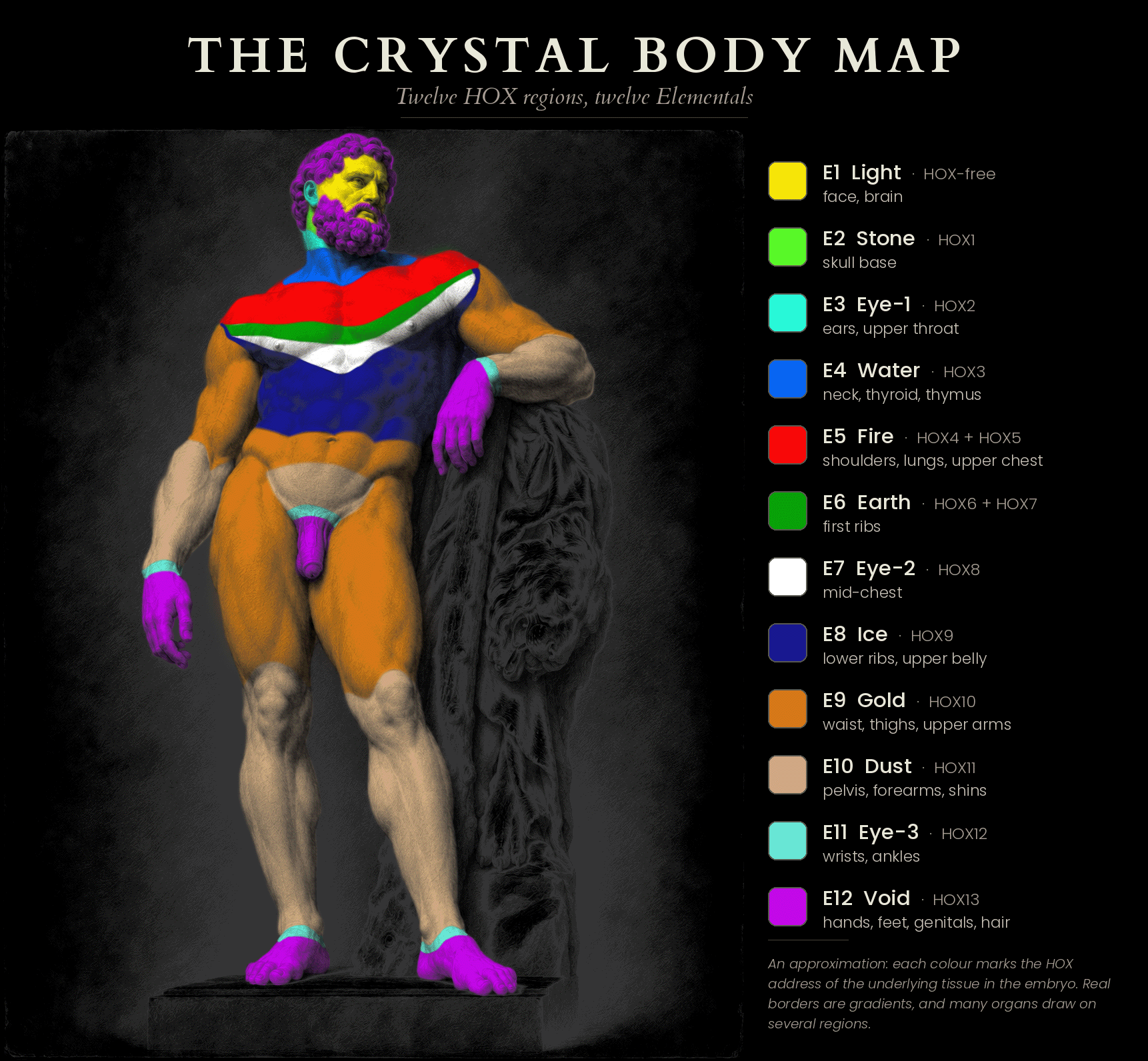
- E1 Light · HOX-free
- face, brain
- E2 Stone · HOX1
- skull base
- E3 Eye-1 · HOX2
- ears, upper throat
- E4 Water · HOX3
- neck, thyroid, thymus
- E5 Fire · HOX4 + HOX5
- shoulders, lungs, upper chest
- E6 Earth · HOX6 + HOX7
- first ribs
- E7 Eye-2 · HOX8
- mid-chest
- E8 Ice · HOX9
- lower ribs, upper belly
- E9 Gold · HOX10
- waist, thighs, upper arms
- E10 Dust · HOX11
- pelvis, forearms, shins
- E11 Eye-3 · HOX12
- wrists, ankles
- E12 Void · HOX13
- hands, feet, genitals, hair
- E1 Light – HOX-free head (brain and face) – The Pure Beginning
- E2 Stone – HOX1 – Skull and Body Foundation
- E3 Eye-1 – HOX2 – Signal Receiving Surface
- E4 Water – HOX3 – Gatekeeper of State Changes
- E5 Fire – HOX4 and HOX5 – Branching Flames
- E6 Earth – HOX6 and HOX7 – Terminal Maturation
- E7 Eye-2 – HOX8 – The Balance System
- E8 Ice – HOX9 – The Threshold
- E9 Gold – HOX10 – Generative Expansion
- E10 Dust – HOX11 – Integration and Hardness
- E11 Eye-3 – HOX12 – The Leap
- E12 Void – HOX13 – Ending and Outreach
- The Bridge – the umbilical cord – where the end returns to the beginning
Closing the Circle
Ten years ago, this line of genes made me suspect that there is more Order than Chaos in nature. After drawing this Map, I am quite sure of it. I do have to add that this Map was a brutish simplification of the beautiful complexity of a human body. However, the broad patterns hold – and not just for humans.
Next time you hold someone’s hand, remember that you are touching their Void, sharing its blueprint with… well, you know what. Enjoy. Hihi.